Philosophy Archive
Editorial Blog
Discipline
Editorial / Interface
Project Overview
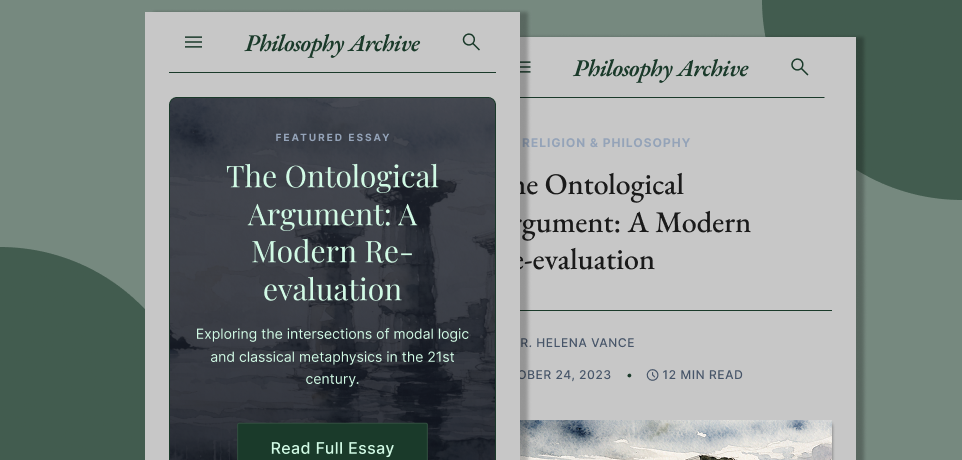
The Philosophy Archive is an editorial blog modeled after the classical schools of philosophy. It serves as a curated collection of philosophical thought where authors can publish essays and journals exploring various schools of thought, from ancient traditions to contemporary ideas. Unlike general blogging platforms, the Archive is purpose-built for long-form intellectual writing. The visual design reflects the content it carries with an intentional minimalist approach. Philosophy demands focus and reflection, and a busy interface would clash with the deeper nature of the material.
The Design Process
I began by researching Substack as a primary competitor to understand how editorial platforms handle content publishing, author identity, and reader engagement. What I found is that most blogging platforms prioritize volume and algorithmic discovery, which works well for news and opinion but creates noise around content that rewards slow, careful reading. The Philosophy Archive is designed to be the opposite. The interface is stripped down to essentials: the writing, the author, and the school of thought. The stone-like visual direction with grey backgrounds and muted green accents was chosen to evoke permanence and calm, the feeling of reading something carved in marble rather than scrolling through a feed. The current design includes wireframes for both desktop and mobile, establishing the foundational layout and content hierarchy that the product will build on.
Key Decisions
The stripped-down interface was the most important decision. It would have been easy to add social features, recommendation engines, or trending sections from the start. Instead I kept the focus on three things: the writing, the author, and the school of thought. That restraint gives the Archive its identity and separates it from platforms that treat every piece of content the same regardless of depth.
The author-driven structure gives writers identity and ownership. Each author has a presence within the Archive, not just a byline. This was inspired by how classical schools of philosophy were organized around thinkers and their lineages of ideas rather than isolated articles.

What I Learned
This project taught me that knowing what to leave out is just as important as knowing what to include. The temptation to add features is strong, especially when competitors have them. But the Archive's strength comes from its simplicity. A forum, a personal archive for readers, and deeper organizational features are all part of the vision, but they need to be introduced carefully so they enhance the experience without undermining the calm, focused environment that makes the platform worth using in the first place.
What's Next
The current design includes wireframes for both desktop and mobile, establishing the foundational layout and content hierarchy. Based on early research, I plan to add a forum where readers can publicly engage with authors, creating the kind of intellectual dialogue that classical schools of philosophy were built around. A personal archive feature will let readers save and organize their favorite content by theme or author. I also plan to investigate additional competitors beyond Substack to identify patterns and opportunities I may have missed. As the product grows across platforms, the goal is to create something that feels less like a blog and more like a living library where philosophical thought is not just published but actively explored and discussed.
Next project — 01
SightMark
Social Media / Sightseeing Product
Based in
Salt Lake City, Utah
Available for
Actively seeking full-time UX roles and freelance projects.